
Risk management is an important part of the sustainable management of an enterprise. To manage the risks faced by each unit of our company's operations and reduce losses caused by risks, we have established the “The Key Points for Risk Assessment and Management.” Its contents encompass risk management policies, the establishment of Taiwan Sugar Corporation Risk Management Promotion Committee, Internal operational procedures and public opinion as reflected in the media and press coverage. The annual evaluation and management of potential risks by each unit based on its operating environment and industry changes. This includes the identification and management mechanisms of various potential risks such as natural disasters and the supply and safety of raw materials for major products like sugar and feed. We will continue to optimize our risk management mechanisms to create a high-quality operational environment, minimize or avoid the occurrence of risks, and achieve our corporate sustainability goals.

Risk Management Organization
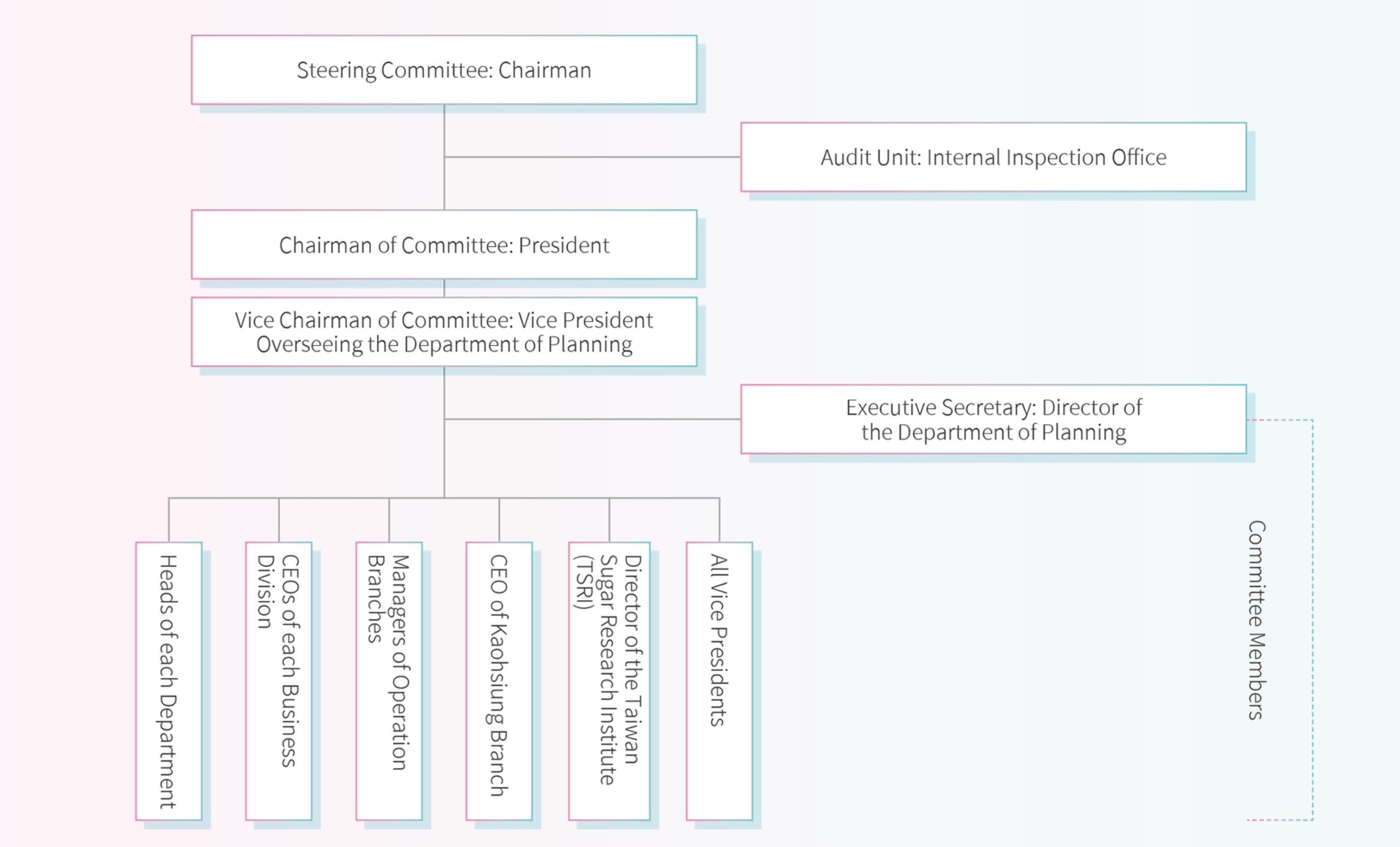
To implement and assist each unit with the promotion of risk management operations, TSC established the Risk Management Promotion Committee, with the chairman serving as the steering committee, the president as the chairman of the committee, the vice president of the Business of the Department of Planning as the vice chairman, and all the vice presidents, the first-level supervisors of all departments (excluding the Internal Inspection Office) as the committee members. Additionally, a certain number of consultants or expert scholars may be hired when necessary.
The responsibilities of the Committee include:
1. Establishing business risk management policies and review their applicability.
2. Implementing an internal control system related for risk management and conducting regular reviews of related business risk items, impact assessments, and management countermeasures.
3. Supervising the implementation of the risk management of business items belonging to (or controlled by) the committee and make proper adjustment and revision of the risk management measures.
4. Other business matters related to risk management.
The director of the Department of Planning concurrently serves as the executive secretary, handling the convening of committee meetings, recording, and other related business. The Internal Inspection Office, BOD is in charge of on-site audits of the appropriateness of the risk management system. As the routine annual audits are conducted across all departments, the execution of relevant operations is included in the scope of audit. Any deficiencies in the internal control system or irregularities identified have been truthfully documented in the on-site audit reports., and following proper reporting and approval procedures, have been subject to ongoing quarterly follow-up until closure.
Risk Management Implementation and the Responsibilities of Departments
Each unit plans and reviews the risk management implementation status on a yearly basis in accordance with the Key Points for Risk Assessment and Management. Every unit should review the risk items of the management business of the current year at the end of every year, and in addition to reviewing the implementation effectiveness of risk management for potential events of losses, business processing analysis (BPA) for the management business in the following year should be carried out, the potential risks shall be listed, the source of events shall be confirmed, and the likelihood of occurrence and the degree of impact of various potential risk items (including common risk events and important risk matters for each department) shall be evaluated as well as set. Cost-effective planning and four risk management strategies should be put into consideration, namely the Risk Aversion, Risk Reduction, Risk Tolerance, and Risk Transfer. Based on the business responsibility of each unit, the risk assessment information identified every year is sent to the Department of Planning, and then to the heads of the departments of the Headquarters for opinions based on the business attributes. After collecting and amending the opinions, they are reported to the president for approval, followed by implementation.
In addition to the risk assessment every year, the heads of the units should conduct simulation drills or tests on a regular basis or occasionally to confirm the effectiveness of relevant control mechanisms when risks occur, and pay close attention to the changes in the risk, make timely assessment and management of the risks. In addition, the competent business units of the Headquarters should make regular or occasional inspection of the handling of risk management of each unit depending on the nature of the business. For matters to be improved, counseling is provided for improvement and tracking is conducted. Furthermore, education and training, organizational learning or on-site drills regarding risk management and crisis handling are organized as needed to establish professional techniques for risk management and crisis handling and improve crisis prevention and handling as well as response capabilities. Continuous review, rolling discussions, and adjustment of the effectiveness and suitability of risk management mechanisms for different business are continuously conducted through the PDCA process.
Other support mechanisms of risk management
The scope of the company business is very
extensive, so various select committees have been established for various
business attributes, such as the Quality Management Committee, Occupational
Safety and Health Committee, Environmental Protection Committee, Information
Security Committee, Labor-Management Meeting, and Integrity Report. Regular
meetings are convened to eliminate or reduce the occurrence and level of impact
of risk events. In addition, high-level “decision-making meeting” and the
company-wide monthly “business briefing” are held regularly to solve problems
concerning business operations or disputes in a timely manner.