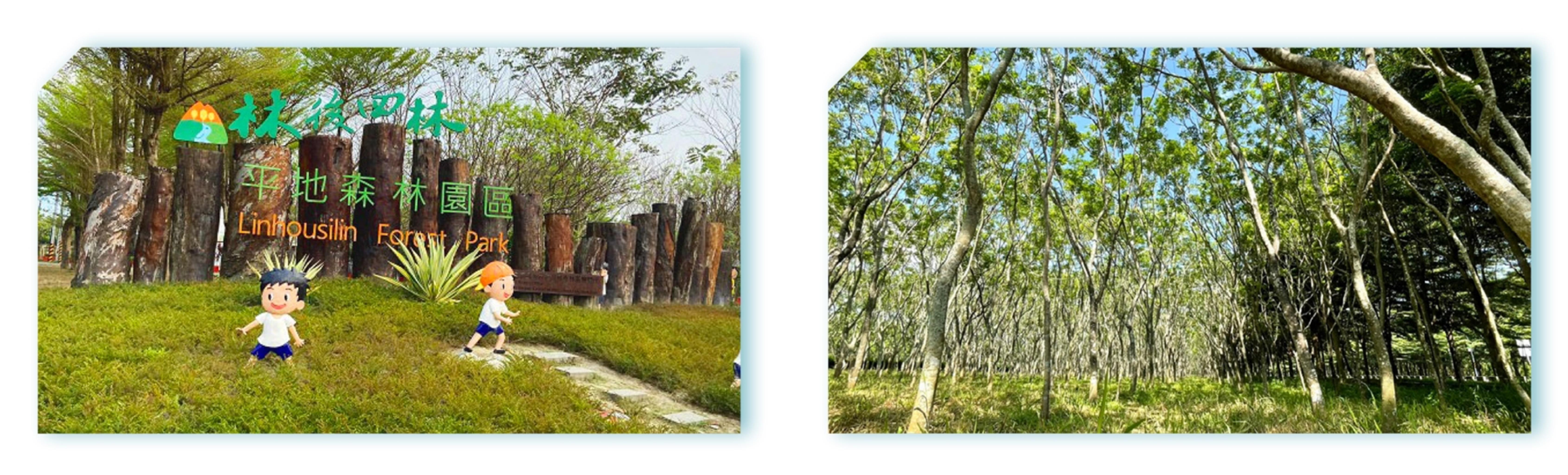
TSC owns extensive land resources. Since 1997, in alignment with government afforestation policies, the company has carried out greening projects on idle land. As of the end of December 2025, the total area afforested and maintained reached approximately 11,358 hectares, accounting for 23.38% of the company’s total land holdings. Notably, the forest parks located in Linhou Silin, Pingtung County, and Danong Dafu, Hualien County—both lowland forest areas—have been connected to surrounding ecological habitats, forming environmentally friendly ecological corridors that serve both conservation and recreational purposes for the public. In addition, four wetland areas have been leased to local governments for integrated planning and management as ecological parks.
Of all the land owned by TSC, 26.69% is used by all district branches. However, due to the changes in the times and industries, only Shanhua, Huwei and Xiaogang Sugar Factories are still in operation. To properly preserve sugar industry facilities, we have repaired and revitalized old sugar factories across Taiwan, promoted sugar industry culture through leisure and tourism activities, and transformed 5 old sugar factories into tourist sugar train parks. Some locations are even combined with local resources or special facilities and planned as environmental education venues.
Diversified Utilization of Natural Resources
As the 20-year afforestation subsidy period expires progressively on an annual basis, TSC continues to appropriately implement thinning operations on existing afforestation land and continue to carry out forest cultivation and management to create the most favorable conditions for the future development of carbon sinks in advance. It also adheres to the initial development vision of the flatland afforestation project- to improve the quality of the living environment of the people and provide recreational and educational functions, cooperate with the Forestry and Nature Conservation Agency "agricultural and forestry eco-tourism", "increase wildlife habitat environment" and "biodiversity" goals, and thus respond to the expectations of society and the people and assume the social responsibility of a state-owned enterprise.
In response to the country's key strategy of natural carbon sinks in the net-zero transition, Taiwan Sugar Corporation is actively developing forest carbon sinks and taking a re-inventory of afforestation land resources as an opportunity to transform forestry policies. Currently, the resource inventory for afforestation on flat land has been completed, with an afforestation area of approximately 10,000 hectares, of which approximately 3,301.55 hectare are sites with habitat and ecological value. We have developed collaboration with the Forestry and Nature Conservation Agency to plan and promote voluntary reduction projects and corporate afforestation mechanisms to gradually expand forest carbon sequestration capacity.
In the future, it will cooperate with external parties and implement self-organized projects, in conjunction with the Ministry of Environment's methodology, to promote the country's net-zero carbon reduction and sustainable development goals.
Revitalization of Sugar Factory Sites
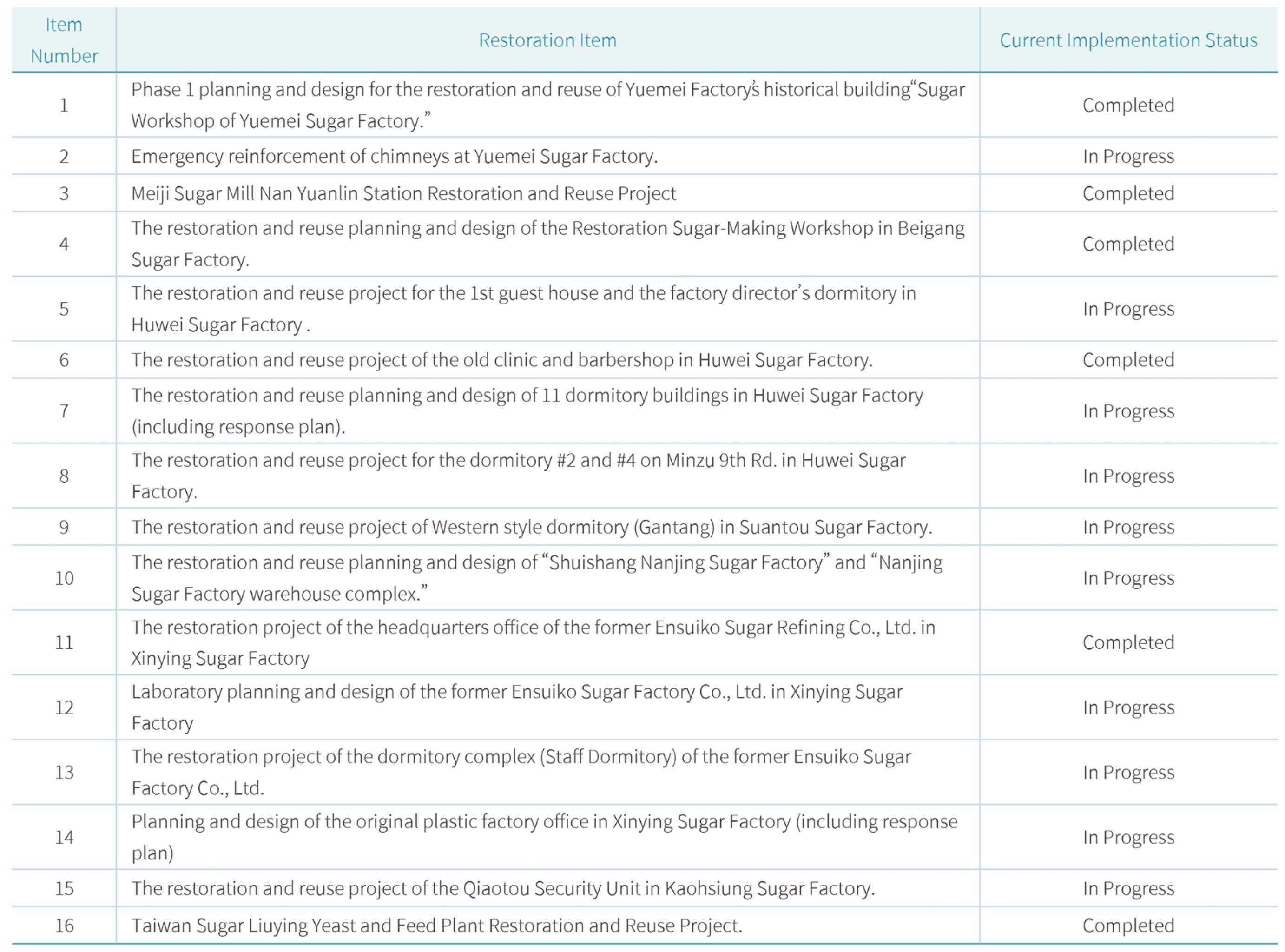
During the Japanese Colonial Period, wooden structures and the industrial facilities in sugar factories had their own styles. These structures not only witnessed the process and transformation of the sugar industry but are also unique historical landscape and a symbol of memories, and is a rare and precious cultural asset. TSC continues to cooperate with the cultural institutions of the government, applies for subsidy projects for the preservation, restoration, management, and maintenance of cultural assets to accelerate the restoration and reuse of idle factory areas so as to achieve sustainable development of industrial heritage. In the future, we will gradually plan to attract investment for arts, commerce, accommodation experience, open visits, cultural relics exhibitions and film shooting activities, transforming it into a cultural and creative industry element with connotation, and enhancing the value of sugar industry cultural assets. In 2025, the company has already allocated NTD 71 million for the preservation, maintenance and reuse of cultural assets to carry out the preservation, maintenance and restoration and reuse of sugar industry cultural assets. The projects organized in 2025 are shown in the following table.
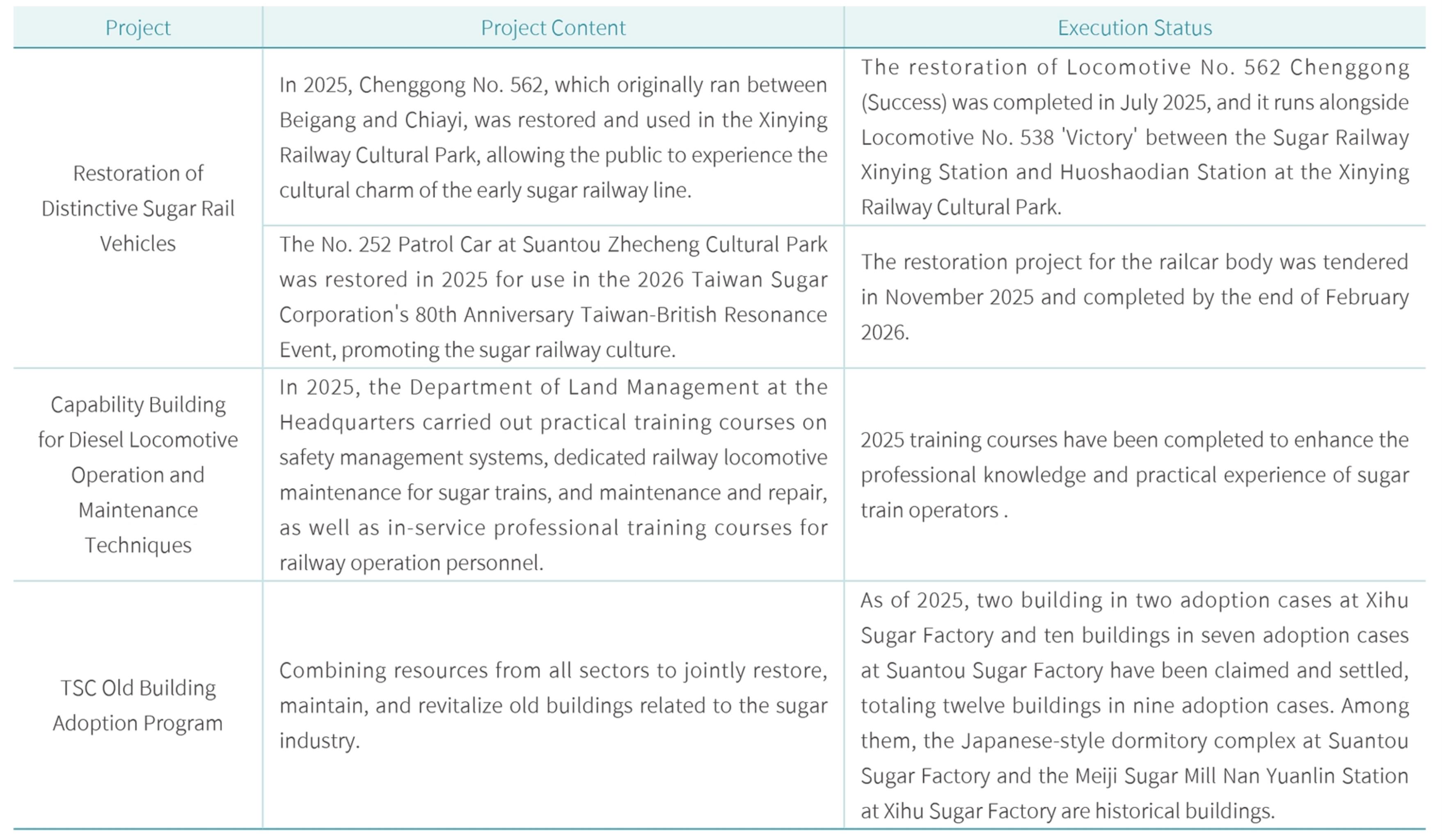
In addition, the sugar train is also a living history that witnesses the development of local industries. In recent years, TSC has continued to invest in transforming important sugar industry cultural assets into future tourism development resources. In addition, external resources are also combined for TSC to actively promote the adoption of old buildings in a variety of ways. The cultural heritage preservation-related projects implemented in 2025 are summarized as follows: