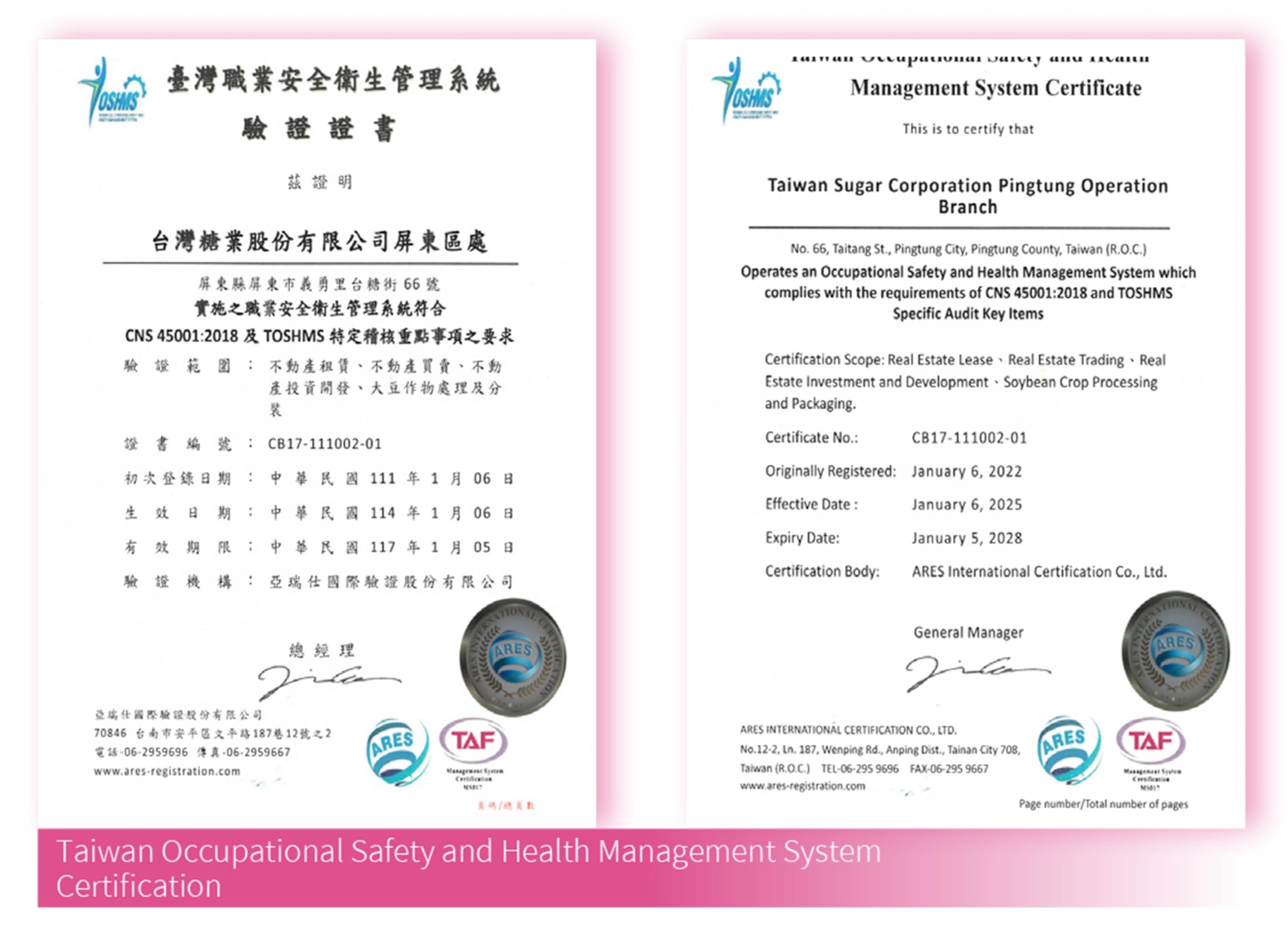
A total of 17 units of TSC, including the Headquarters, Xiaogang Plant of the Sugar Business Division, Shanhua Sugar Factory, Huwei Sugar Factory, Biotechnology Business Division, Petroleum Business Division, Kaohsiung Branch, Chungchang Operation Branch, Yunchia Operation Branch, Tainan Operation Branch, Kaohsiung Operation Branch, Pingtung Operation Branch, Livestock Business Division, Agriculture Business Division, Marketing Business Division and Liuying Jianshanpi Resort (Leisure Business Division) have implemented ISO 45001 and CNS 45001 Occupational Safety and Health Management System and passed the verification and obtained certificate in accordance with Article 23 of the Occupational Safety and Health Act where the scale of business entities in the preceding paragraph reaches or exceeds a certain level or have workplaces as stipulated in Article 15 Paragraph 1.
The total number of employees was 3,272 (including self-employed, temporary, and part-time personnel), and the total number of non-employees was 3,130 (including non-permanent dispatched workers), accounting for 100% of the workforce. (Calculated based on the average monthly number of employees for the applicable year.)
In order to integrate matters regarding occupational safety and health management and improve performance in occupational safety management, the “TSC Occupational Safety and Health Management Information System” was established to manage occupational safety online. In addition to sharing information and saving data online, it also accelerates data transmission and simplifies the procedures. Furthermore, it aims to reduce paper usage for environmental conservation and establishes a communication channel with employees to improve workplace safety and health.
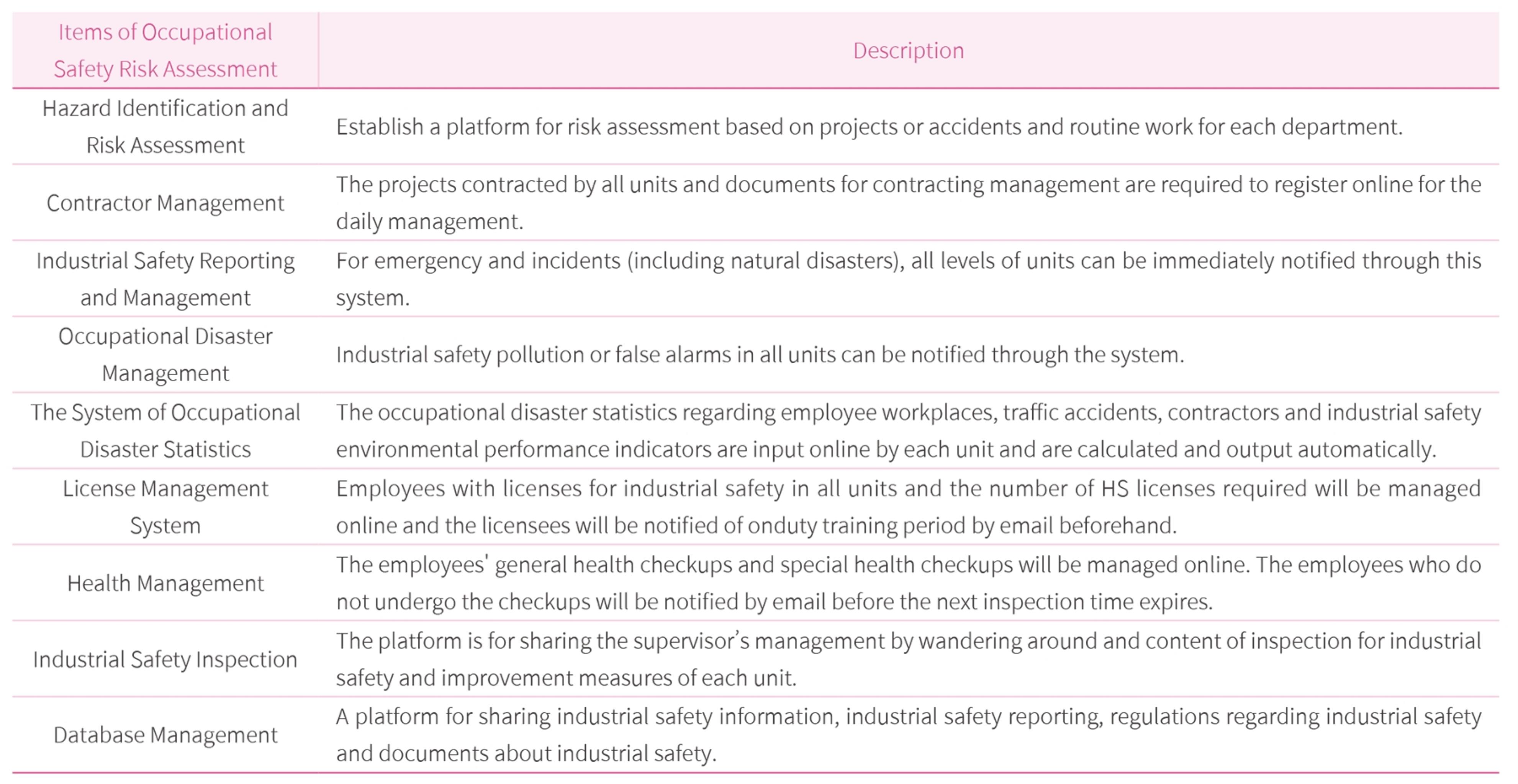
Hazard Identification and Risk Assessment
The head of each unit assigns personnel for “hazard identification and risk/opportunity assessment operations” for the relevant education and training organized by Occupational Safety and Health Department for 3 hours and more, and such personnel will be responsible for hazard identification and risk/opportunity assessment operations within the unit. Every September, it is necessary for them to confirm the hazard identification and risk/opportunity assessment operations online at the “TSC Occupational Safety and Health Management Information System” and publicize the hazards in the workplace and preventive measures. Hazard identification and risk/opportunity assessment are conducted using a matrix analysis based on the formula: Operational Exposure Frequency × Probability of Occurrence = Risk Possibility. The risks are then categorized into six levels of control. Moreover, when any of the following situations occurs, hazard identification and hazard evaluation of relevant operations have to be re-implemented.
1. When the standard provisions of Taiwan Occupational Safety and Health Management System (TOSHMS) are revised.
2. When the new processes, change of processes, new equipment, change of raw materials, or changes of operating environment conditions (including the development of target plans before taking the non-conforming corrective measures) will obviously affect the case of the risk, hazard identification and risk/opportunity assessment shall be conducted before the changes start.
3. When an unexpected incident happens.
4. When a regulatory change is sufficient to affect the risk scores.
5. When there are more than 3 false alarms of the same nature or in the same area.
6. When it is strongly requested by the stakeholders.
7. When major deficiencies are found in the inspection or audit.
The head of each department should also establish corresponding control measures based on the results of the hazard identification and risk assessment (risk level). Occupational Safety and Health Department also visits the workplace from time to time to discover potential hazards, make suggestions, propose improvement measures, and organize the List of Unacceptable Risks.
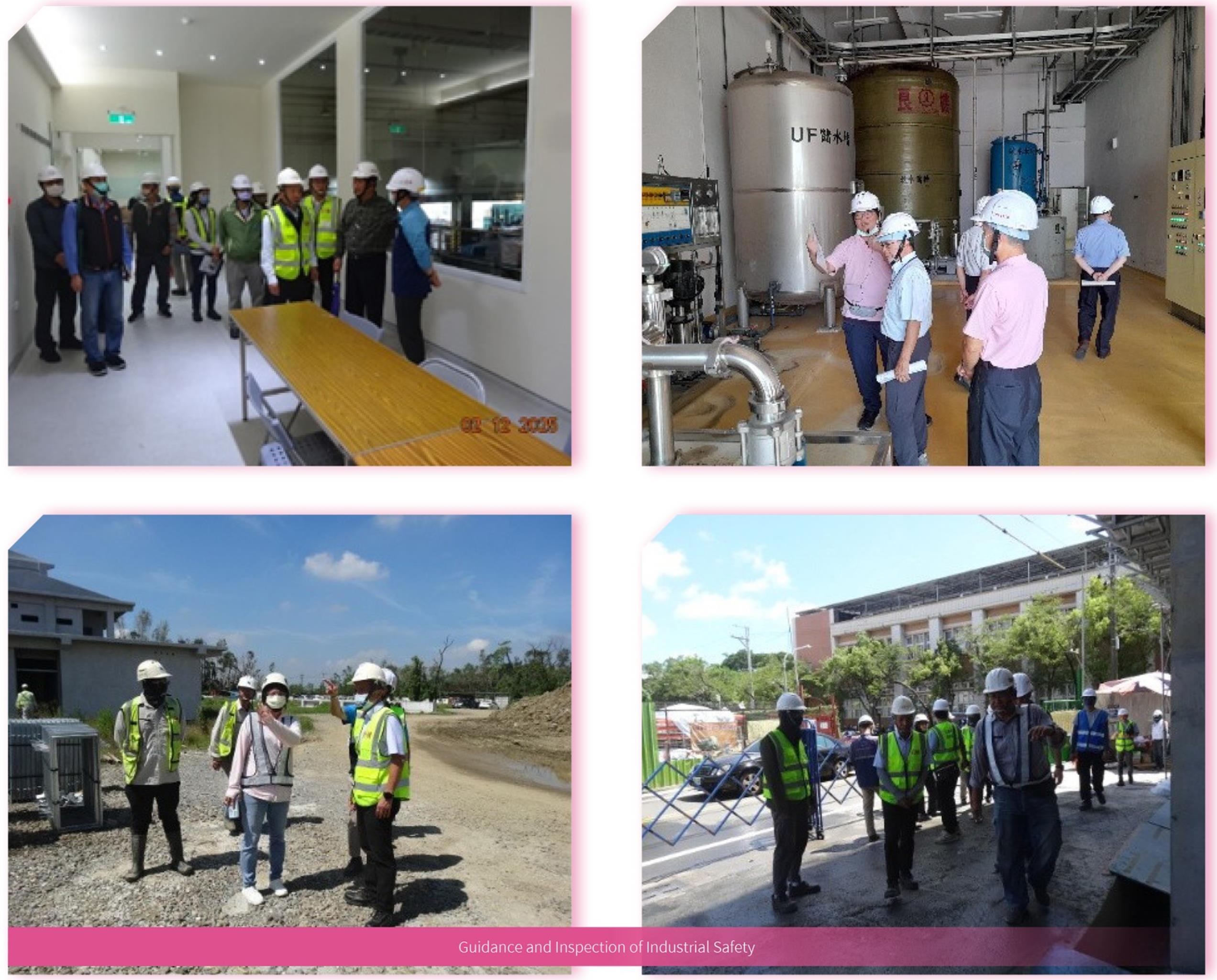
Guidance and Inspection of Industrial Safety
In order to implement the management of industrial safety and strengthen the inspection of industrial safety, the annual "Industrial Safety Inspection Plan" is established according to the nature of business. Items to be improved are proposed and tracked until they are improved to ensure the safety of factory sites, business sites and workplaces and prevent disasters from happening so as to improve occupational safety and health management performance. In addition, through the walking management of high-level executives, high-level executives at all levels will be sent to each unit for guidance and inspections from time to time.

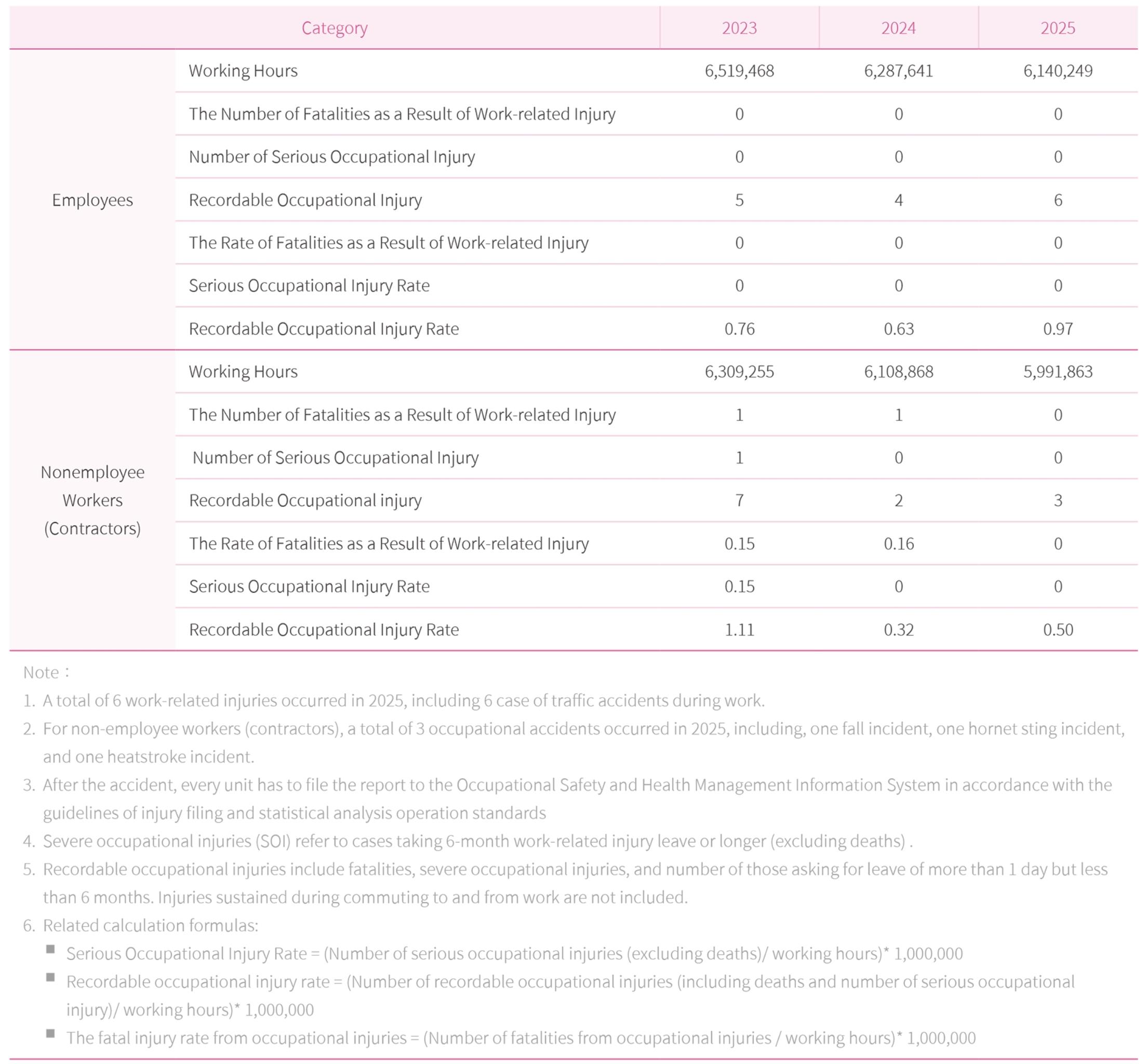
Occupational Safety Performance Indicators
TSC attaches great importance to the safety of the working environment of employees and contractors; and is commited to creating a safe operating environment. In 2025, there have not been any occupational disease related cases among our employees and contractors.