The investors and the industry chain are attaching more importance to issues related to governance, environment, and social sustainability. To have proper communication with the stakeholders, TSC has established multiple communication channels and continuously enhanced the transparency of corporate information disclosure. TSC operates in accordance with all laws and regulations in economic, environmental, and social aspects and strengthens the corporate business and the employees’ code of conduct through the internal control system and education & training on the basis of compliance. External donations or sponsorships are handled in accordance with relevant laws and regulations and internal regulations to prevent the incident of offering of accepting a bribe and illegal political contributions. Anti-corruption assessment is conducted through the Department of Ethics on a regular basis to improve the anti-corruption management measures. In 2025, TSC did not engage in any public policy lobbying or political donation and was not involved in any legal actions related to anti-competitive behavior, anti-trust and monopolistic conduct.
In response to the requirement under the Regulations Governing Establishment of Internal Control Systems by Public Companies, listed and OTC-listed companies shall establish internal control mechanisms governing the management of sustainability information starting in 2025, and incorporate them into their internal audit plans. TSC completed revisions to its “Key Points for the Disclosure and Compilation of Sustainability Information” in July 2025, incorporating sustainability information management into its internal control system to enhance the credibility of sustainability information. The 2025 audit plan was approved by the Audit Committee on November 8, 2024, and approved by the board of directors on November 29, 2024, which has been included in the sustainable information management operations.
Improve self-monitoring
The Taiwan Sugar Corp. Internal Control System and related regulatory documents are formulated in accordance with the "Regulations Governing Establishment of Internal Control Systems by Public Companies" and the "Key Points for Implementation of Internal Inspection of Public Institutions Affiliated to the Ministry of Economic Affairs", and implemented to promote the company's sound management. The Internal Inspection Office of the Board of Directors assists the board of directors and managers with the examination and review of the deficiencies in the internal control system and the evaluation and efficiency of the operations in accordance with the above-mentioned standards and implementation key points, and timely suggestions will be provided at any time.
Under the trend of digital transformation, the Internal Inspection Office of the Board of Directors has proposed the Digitalized Self-Assessment Program for the Internal Control System was officially implemented in 2024. Through the company's internal NAS cloud management, each unit can systematically save self-assessment work data and implement a self-monitoring mechanism. In addition to improving overall work efficiency, it is estimated to save approximately 42,000 sheets of paper each year (based on the estimate of 14,000 control operations of TSC's self-assessment, and each item requires no less than 3 supporting documents as prescribed by regulations).
In addition, the staff in Internal Inspection Office of the Board of Directors have a number of international and domestic professional certificates and qualifications of Certified Internal Auditors (CIA), CCSA (Certification in Control Self-Assessment), Lead Auditor (Information Security Management Systems), International Certified CAATs Practitioner (ICCP), Jacksoft Certified CAATs Practitioner (JCCP), Procurement Professional (basic) Qualification, etc. The auditors will demonstrate a proactive attitude toward adapting to technological changes and engaging in continuous learning to enhance the professional standard of internal auditing.
To respond to changes in the internal and external environment in a timely manner and ensure that the design and implementation of the internal control system are continuously effective, TSC added 2, revised 24, and abolished 2 internal control system documents in 2025. The implementation of the internal control system is also included in the annual work assessment project to promote the self-management of each unit and implement the self-supervision mechanism. In addition, the Internal Inspection Office of the Board of Directors has completed on-site audits of 16 internal units in accordance with the 2025 internal audit plan, and has carried out special audits and irregular audits of related businesses. After the audit results are reviewed by the head of the company, in addition to informing the audited units to make improvements within a specified period, they will also be delivered to the independent directors for review in accordance with regulations. As of the end of 2025, a total of 1,087 improvements and suggestions have been proposed, and subsequent quarterly follow-ups will be conducted until the improvements are fully implemented.
The Chief Auditor attends the monthly board meetings to understand the board’s decisions on organizational and control matters and reports on audit work. At the same time, to strengthen communication with independent directors, the Chief Auditor reports on audit work to the Audit Committee on a regular basis each year.
Elimination of Malpractice and Whistleblower Protection Policy
All TSC employees abide by the “Ministry of Economics Employee Integrity and Ethics Rules.” To guide the behavior of personnel in accordance with ethical standards and ensure that the company's activities are in line with social norms, we have also established the "Codes of Ethical Conduct of TSC," which applies to TSC personnel, including directors (including independent directors) and managers (including the president, vice presidents and directors of various units). The implementation of this code is reported to the board of directors annually in October by Department of Human Resources in collaboration with Department of Ethics, aimed at reducing the likelihood of fraud occurrences.
We ensure the confidentiality of reported cases to encourage our employees or the public to report on illegality or violations so as to prevent malpractice and urge relevant units to make improvement in a timely manner. TSC has established the Key Points for the Implementation of Confidentiality of Whistleblowing Cases in the internal control system in accordance with the Personal Information Protection Act, the Anti-Corruption Informant Rewards and Protection Regulation, Corporate Governance Best Practice Principles for TWSE/TPEx Listed Companies, and TSC’s Code of Ethical Conduct, which serve as the basis for the establishment of an operation process for each unit to handle whistleblowing cases with the principles of confidentiality, legality, rationality, promptness, certainty, and prudence. The aforementioned Key Points were renamed as the "Implementation of Confidentiality of Whistleblowing Cases and Whistleblower Protection" in November 2023, with additional content related to whistleblower protection.
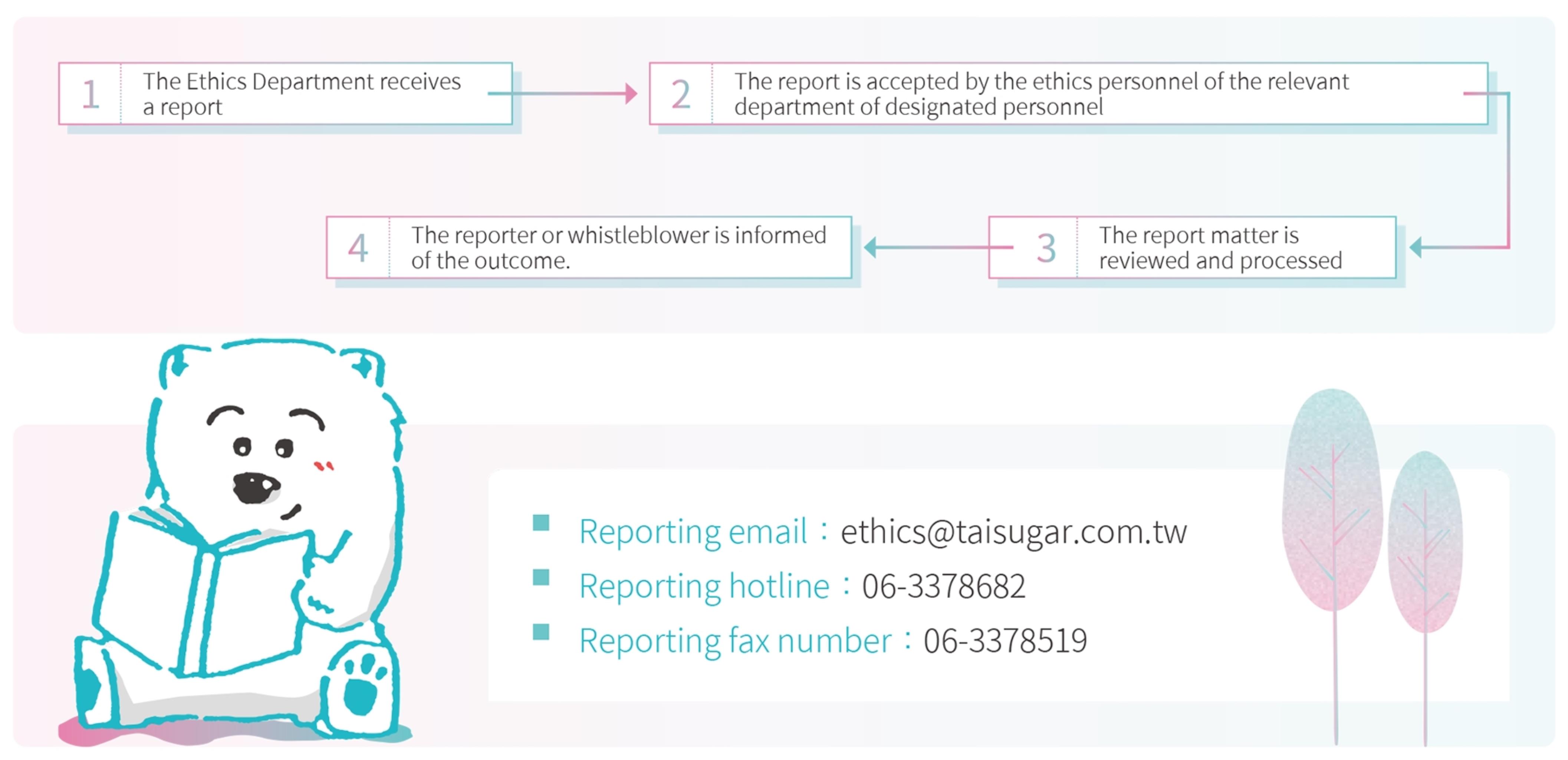
In accordance with the "Act of the Establishment and Management of the Government Employee Ethics Units and Officers," ethics units were established in the headquarters and various units to regularly review integrity risks and fulfill the functions of promoting benefits and eliminating malpractices. In 2025, a total of 16 integrity reports were held. Additionally, various reporting channels have been established, such as dedicated reporting mail box, reporting hotlines, and fax lines, for the public to report grievances and petitions. This information is made publicly available in bidding notice and the official website of Taiwan Sugar Corporation.
Anti-corruption Risk Assessment and Education
To implement the early warning of anti-corruption and corruption risk management behavior, Department of Ethics conducted a corruption-related risk assessment for 17 units under it in 2025, which accounted for 100% of the Company’s total number of business locations. The risk profile of the organization is examined one by one (including incidents and personnel), and the risk responses and improvement shall be researched and proposed while the agency integrity risk assessment report shall be written. It is indicated in the risk report that no major corruption cases occurred at TSC in 2025.
In order to publicize anti-corruption policies and related procedures, the Department of Ethics and Ethics Offices of all units involved enabled the Company's employees to understand relevant anti-corruption regulations and make anti-corruption efforts by multi-advocacy methods such as organizing the relevant anti-corruption education and training, holding a workshop of manufacturers, inviting experts and scholars to give special lectures, issuing and disseminating documents and using electronic information equipment for the internet advocacy and questionnaire surveys. In 2025, anti-corruption policies were communicated to all board members, achieving 100% coverage.
In addition to promoting laws related to the Sunshine Act in 2025, prosecutors from local prosecutors' offices in various counties and cities were invited to give lectures and organize anti-corruption promotion activities including "Procurement Illegality and Case Sharing", "The Legal Status of Employees in State-Owned Enterprises under Criminal Law", "Government Procurement Regulations and Case Analysis", "Gas Station-Related Violation Cases", "Anti-Corruption Rule of Law Workshop" and "Integrity Risks and Anti-Corruption Ethics Standards for Employees in State-Owned Enterprises in Business Operations". A total of 156 sessions were held, with a total of 1,227 participants. Through case analysis, participants understood relevant laws and regulations, strengthened their awareness of anti-corruption, and built consensus on anti-corruption.
The monthly anti-corruption e-magazine for Integrity at TSC is sent to all employees via email. The contents include Publicity of Rule of Law, “Promotion of Safety Maintenance in Government Agencies”, Maintenance of Official Secrets Advocacy, Consumer Protection Advocacy, “Event Promotion” and “Promotion of Green Energy”, to help the employees establish the correct legal understanding. In view of the potential legal risks associated with procurement operations, relevant procurement personnel were provided with communication and guidance on the Company’s anti-corruption policies. As of 2025, 1,227 employees had completed the communication program, accounting for 40% of all employees, while 544 supervisors completed the program, accounting for 95% of all supervisors. In the future, we will continue to plan related advocacy and training programs, gradually expanding their reach to more comprehensively implement anti-corruption policies.
To establish a proper anti-corruption management model for the supply chain, when conducting various procurement tenders, we also outline anti-corruption communication and whistleblowing channels in the contract bidding guidelines to inform bidders. Anti-corruption policy communication has been completed with 100% of business partners. No corruption incidents were reported within the Company in 2025.