
The recruitment is based on the Employment Services Act, Labor Standards Act and “Regulations for the Employment of the Personnel of Business Units Affiliated with the Ministry of Economic Affairs.” In addition, for specialized or technical personnel with special business nature, it is possible to hire them in an open manner as contract employees. Recruitment of talents complies with legal regulations that require the protection of employee human rights, personal privacy, and the prohibition of improper discrimination. In the recruitment of talents, the Company upholds the principles of fairness, justice and integrity. Recruitment, selection, and hiring of employees are all in compliance with government regulations. There will be no discrimination and differential remuneration.
Talent Retention
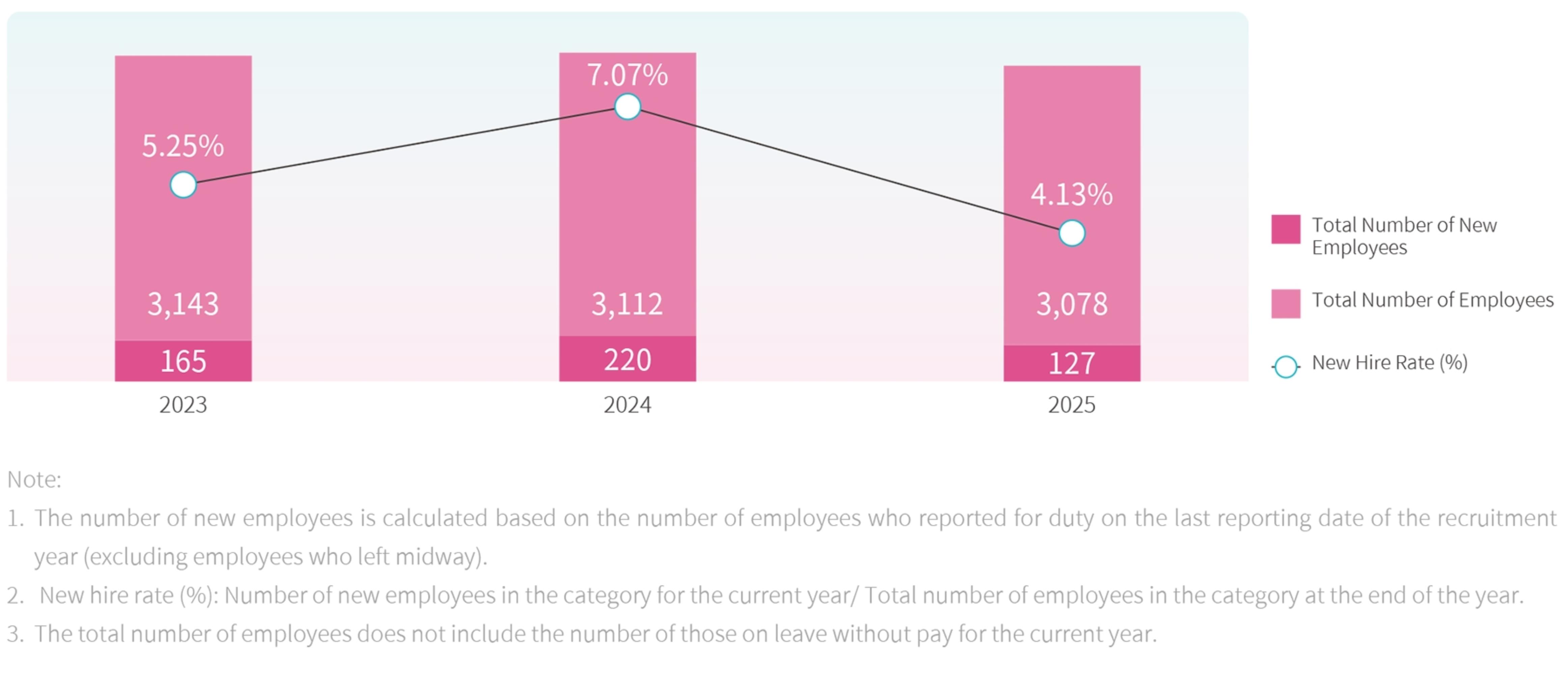
In order to retain competitive talents, TSC strives to establish a friendly working environment, pay attention to the balance between work and life, provide employees with training and development opportunities and encourage employees to continuously improve themselves to achieve the development of individual careers. In recent years, new blood has been activated and most new employees recruited are under 30 years old. The number of employees entering and leaving TSC in the last three years was as follows.
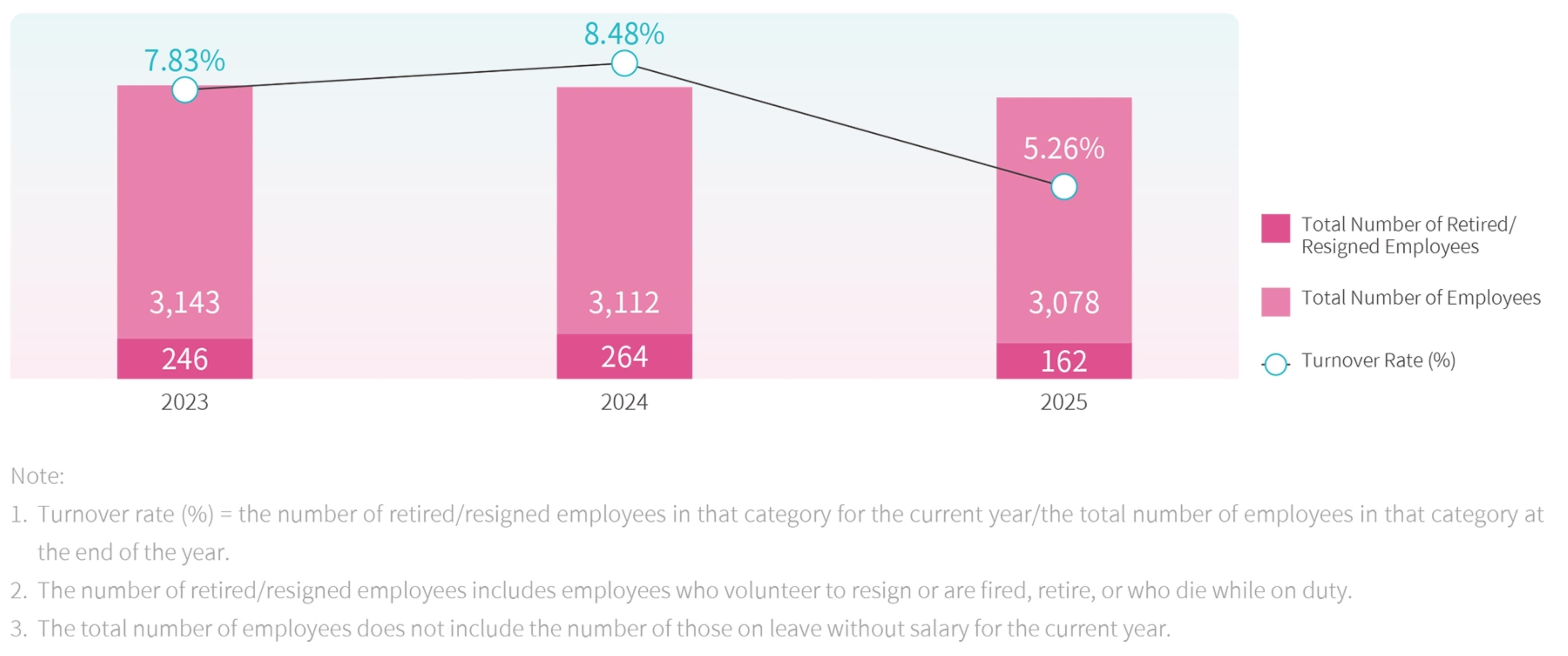
Of the 162 people who left the Company in 2025, 69.75% were retirees. TSC handles the relevant procedures in accordance with the “Regulations Governing the Pension”. The pensions contributed are deposited in the special accounts of the trust department of the Bank of Taiwan. The Employee Pension Management Committee and the Supervisory Committee of Business Entities’ Labor Retirement Reserve are responsible for management and supervision. For workers choosing the new pension system, 6% of their monthly salary is set aside as their retirement pension.
Reinstatement After Parental Leave
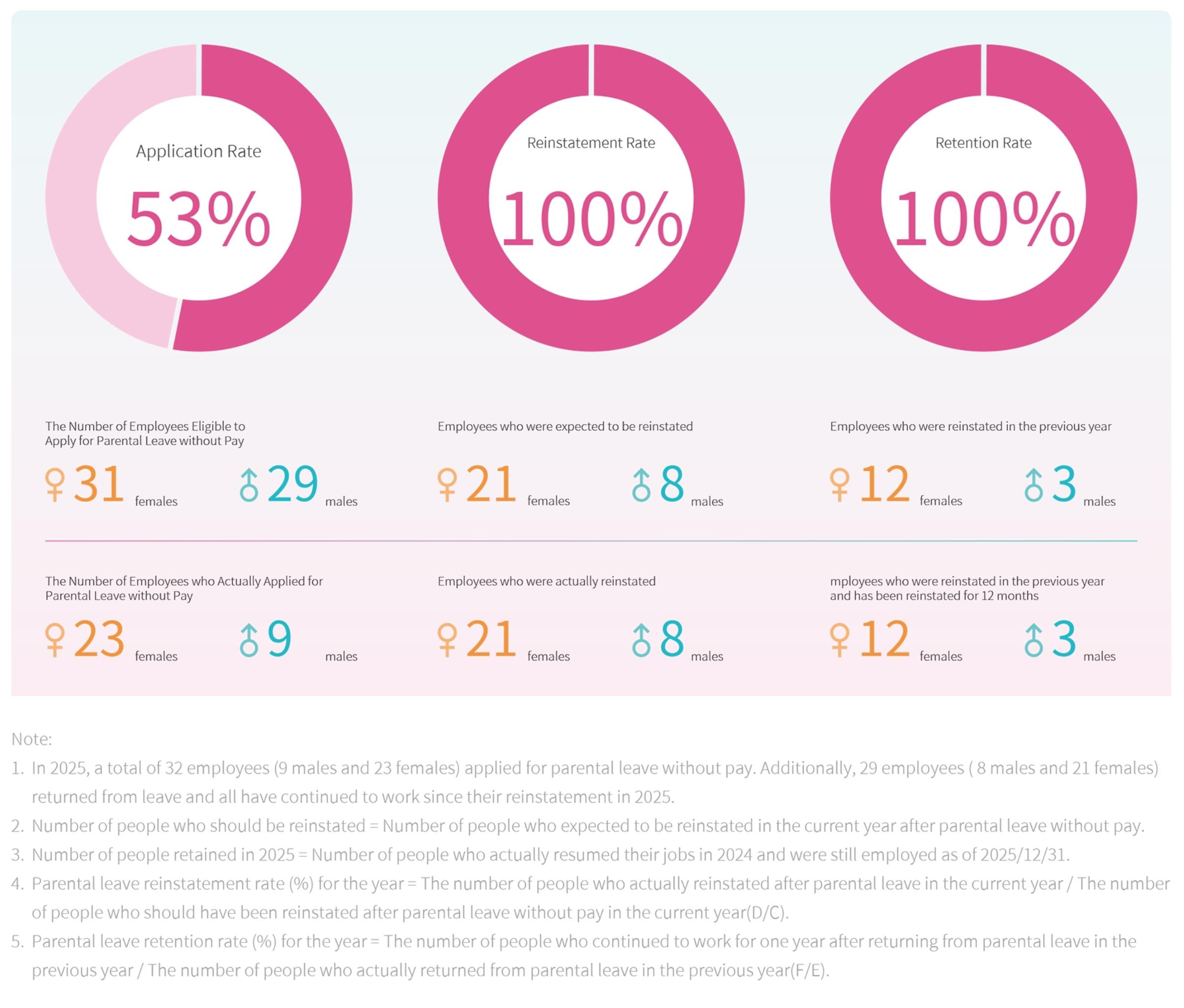
There is no difference regarding parental leave without pay due to gender, job titles and work areas. Both male and female employees can apply for parental leave without pay. To retain outstanding employees, if an employee needs to provide care for infant, or for immediate blood relatives of oneself or one’s spouse who are over 65 years old or suffering from severe illnesses or injuries, he or she can apply for unpaid leave with job retention, and the months of employment within the year may be aggregated while continuity is not a prerequisite. Participation in another appraisal will be rewarded with performance bonuses based on the appraisal results. Additionally, employees who shorten their working hours by one hour due to childcare are provided with one hour of paid time off daily.
In addition, TSC offers benefits exceeding legal regulations, including a paid work hour reduction policy for employees with childcare needs, allowing them to work one hour less per day while maintaining full pay. This supports employees in balancing family care responsibilities and career development. In 2025, the return-to-work rate and retention rate following parental leave reached 100%.
Advance Notice of Operation Change
Where TSC terminates a labor contract pursuant to Article 11 or the provisions of Article 13, the provisions set forth below shall govern the minimum period of advance notice:
✦ Where a worker has worked continuously for more than three months but less than one year, the notice shall be given ten days in advance.
✦ Where a worker has worked continuously for more than one year but less than three years, the notice shall be given twenty days in advance.
✦ Where a worker has worked continuously for more than three years, the notice shall be given thirty days in advance.
After receiving the advance notice referred to in the preceding paragraph, a worker may during working hours, ask for leave of absence for the purpose of finding a new job. Such leave of absence may not exceed two work days per week. Wages shall be paid during such leave of absence. Where an employer terminates the contract without serving an advance notice within the time limit prescribed in the first paragraph of this article, he/she shall pay the worker wages for the advance notice period.