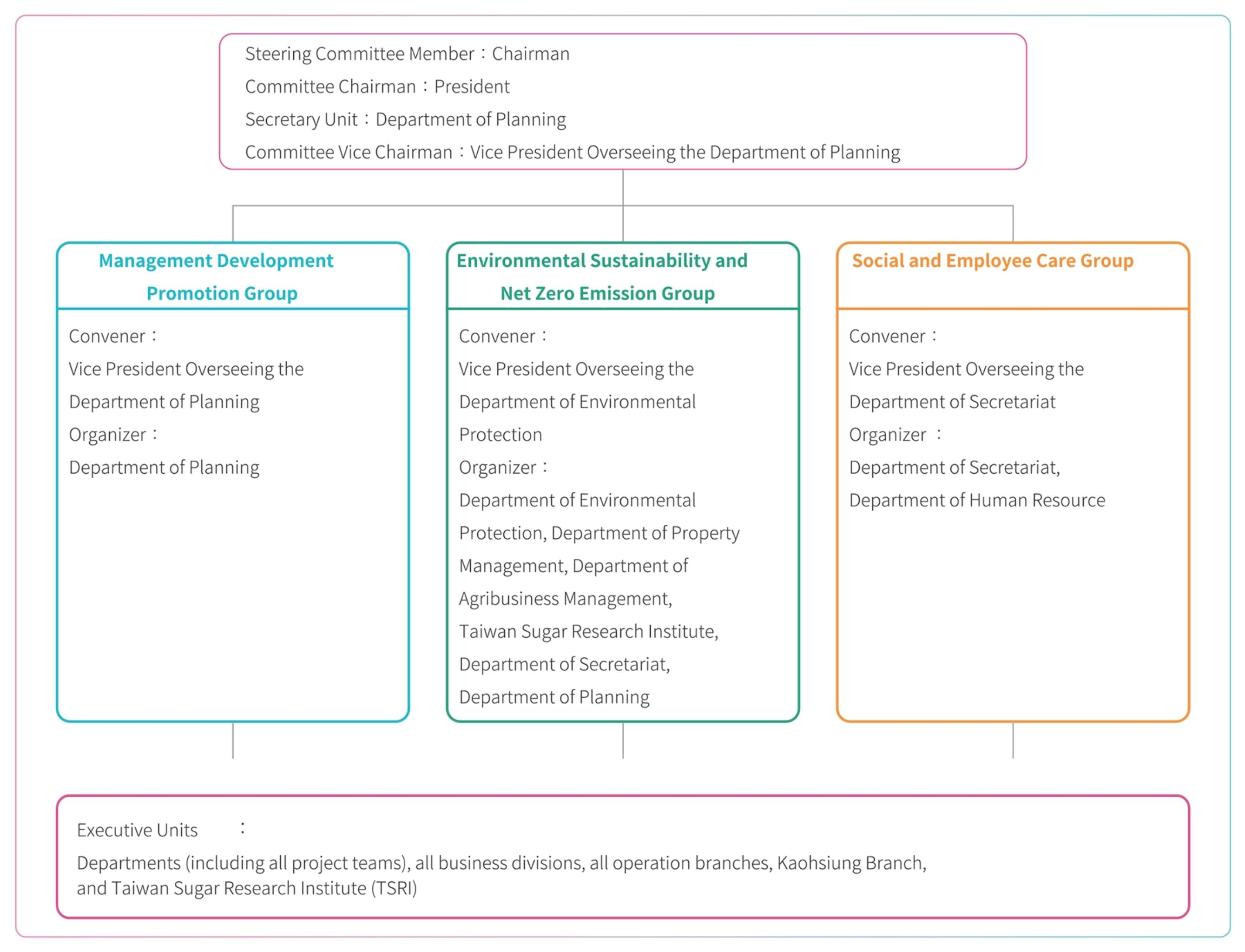
TSC’s Corporate Sustainable Development Committee
TSC has established the “TSC Corporate Sustainable Development Committee," chaired by president, with the chairman serving as the steering member attending committee meetings on behalf of the board of directors. The committee includes members who are vice president and unit managers. Subcommittees under the committee include the "Management Development Promotion Group," "Environmental Sustainability and Net Zero Emission Group," and "Social and Employee Care Group," each led by vice president overseeing responsible for their respective areas of Governance (G), Environment (E), and Social (S) issues. Future business strategies related to sustainable development are submitted to the board of directors for deliberation annually, and it is submitted to the board of directors for review in Q4 of every year.
The committee generally convenes one annual meeting, with additional meetings called by the chairperson when necessary. Its responsibilities include setting sustainable development policies, systems, related management guidelines and procedural documents, and incorporating the corporate sustainable development into the corporate operations and development directions. The organizers of each working group will set the group’s work plan for the following year based on the execution status of the annual business and track the implementation of the plans of the current year. Secretary unit (Department of Planning) will then organize the submitted results and report them to the committee.
Vice President overseeing the Department of Planning concurrently serves as the Chief Sustainability Officer (CSO), marking a new milestone in the sustainable management of TSC.
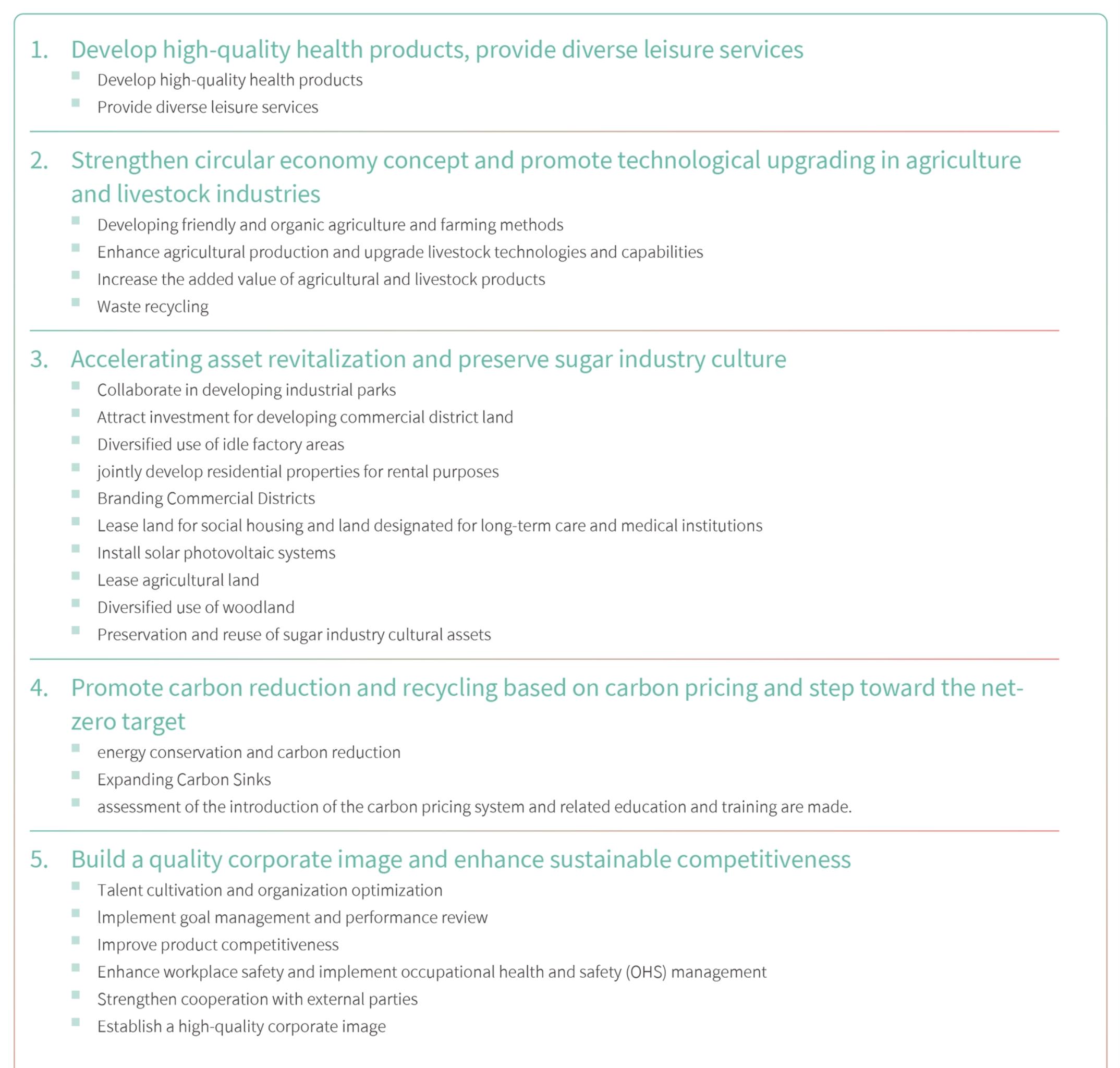
TSC’s Sustainable Development Strategies
The scientifically confirmed impacts of
climate change have prompted significant international attention, with
countries around the world declaring “net-zero emissions by 2030 or 2050” and actively formulating carbon reduction policies. In line
with the global net-zero trend, Taiwan announced its goal of achieving “Net Zero by 2050” in 2021.
The trend of net zero transformation has
emerged. For enterprises, the problems that will be directly or indirectly
brought by extreme weather would impact corporate operations, responses to
scenarios such as the low-carbon economy, carbon reduction lifestyle, disaster
prevention, and energy shortage should also be made. TSC continued to monitor
international climate change adaptation trends, conducted GHG inventories, and
developed carbon reduction strategies. Taking into account the volatile
international situation and TSC's own strengths and weaknesses, the overall
business strategies for the following six years were set up in the face of the
challenges and opportunities the Company is facing. Furthermore, the attainment
status is reviewed and relevant strategies are adjusted on a yearly basis by
applying PDCA. In addition to continuously improving operational performance,
we also plans our business blueprint based on government policies and changes
in the industry environment. Focusing on the core of “Promoting New
Agriculture” and “Circular
Economy,” and having the major strategies .These
operational strategies align with the aforementioned core pillars of business
development, promoting TSC's business upgrade, energy transition, and land
resources utilization projects.